
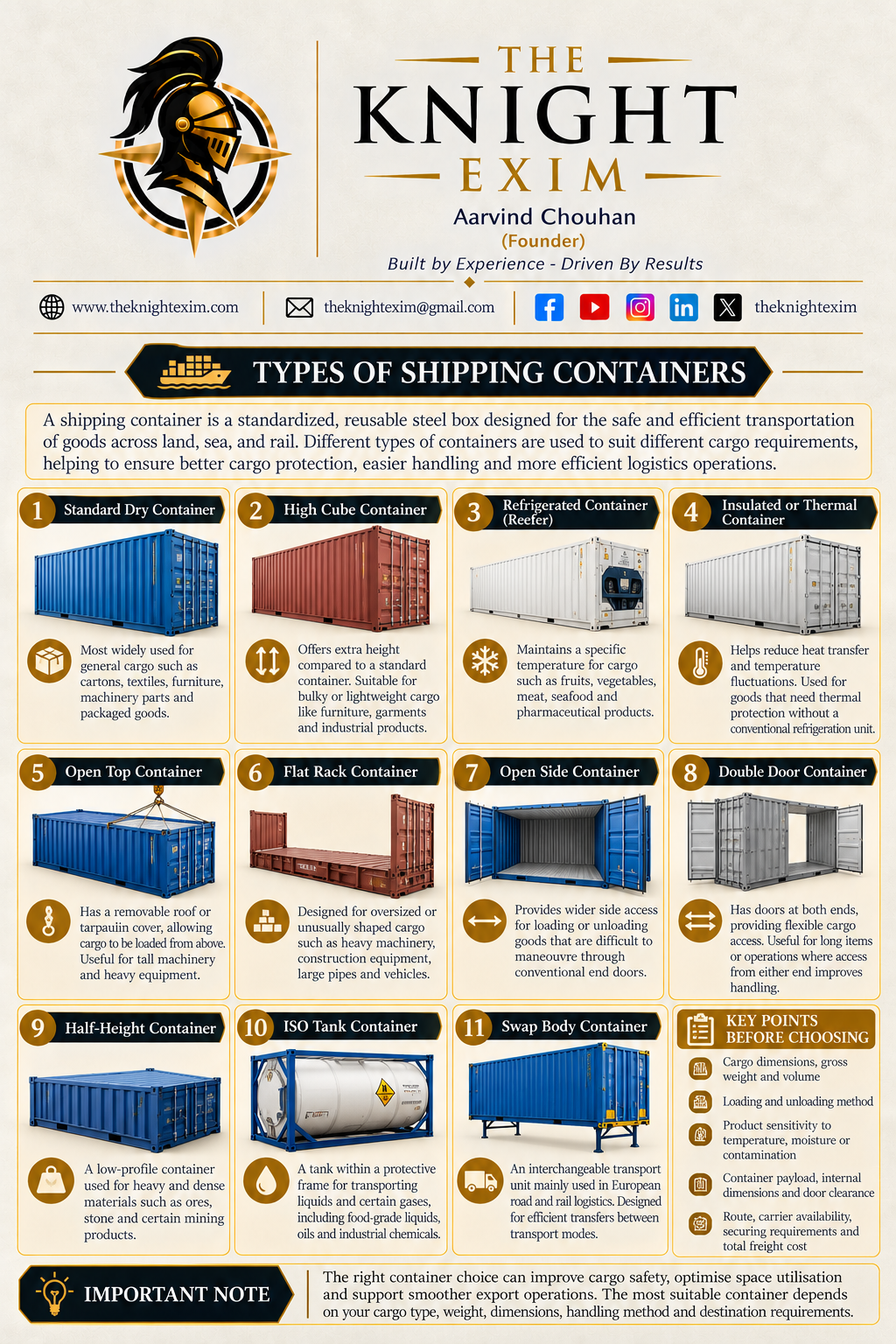
In international trade, a shipping container is more than just a steel box. It is an essential part of cargo protection, logistics planning and cost management.
🚢 𝐒𝐇𝐈𝐏𝐏𝐈𝐍𝐆 𝐂𝐎𝐍𝐓𝐀𝐈𝐍𝐄𝐑𝐒 : 𝐓𝐇𝐄 𝐑𝐈𝐆𝐇𝐓 𝐂𝐇𝐎𝐈𝐂𝐄 𝐌𝐀𝐓𝐓𝐄𝐑𝐒! 🌍
Different goods require different container designs. Choosing the right one can help improve cargo handling, use space efficiently and reduce the risk of damage during transportation.
📦 IMPORTANT TYPES OF SHIPPING CONTAINERS
1️⃣ Standard Dry Container
The most widely used container for general cargo, including cartons, textiles, furniture, machinery parts and packaged consumer goods.
2️⃣ High Cube Container
Offers additional height compared with a standard container, making it suitable for bulky or lightweight cargo such as furniture, garments and certain industrial products.
3️⃣ Refrigerated Container (Reefer)
Designed to maintain a specified temperature for cargo such as fruits, vegetables, meat, seafood and selected pharmaceutical products. Temperature requirements must be planned before shipment.
4️⃣ Insulated or Thermal Container
Helps limit heat transfer and temperature fluctuations. Depending on its design, it may be used for goods that need thermal protection without the same refrigeration arrangement as a conventional reefer.
5️⃣ Open Top Container
Features a removable roof or tarpaulin cover, allowing cargo to be loaded from above. Useful for tall machinery, heavy equipment and cargo handled by cranes.
6️⃣ Flat Rack Container
Designed for oversized or unusually shaped cargo that cannot fit inside a standard enclosed unit. Common applications include industrial machinery, construction equipment, large pipes and certain vehicles.
7️⃣ Open Side Container
Provides wider side access for loading or unloading goods that are difficult to manoeuvre through conventional end doors, including long items and bulky packages.
8️⃣ Double Door Container
Has doors at both ends, making cargo access and loading sequences more flexible. It can be useful for long items or operations where access from either end improves handling.
9️⃣ Half-Height Container
A low-profile container built for heavy, dense materials such as ores, stone and certain mining products. Its design can simplify loading and unloading in demanding industrial environments.
🔟 ISO Tank Container
A tank mounted within a protective frame for transporting compatible liquids and certain gases, including food-grade liquids, oils and industrial chemicals. Product compatibility, cleanliness and safety requirements are essential.
1️⃣1️⃣ Swap Body Container
An interchangeable transport unit mainly used in European road and rail logistics. Its design supports efficient transfers between transport modes, but many swap bodies are not suitable for stacking or ocean carriage like standard ISO containers.
📌 BEFORE BOOKING A CONTAINER, CHECK THESE 5 THINGS :
✅ Cargo dimensions, gross weight and volume
✅ Loading and unloading method
✅ Product sensitivity to temperature, moisture or contamination
✅ Container payload, internal dimensions and door clearance
✅ Route, carrier availability, securing requirements and total freight cost
💡 A practical tip for exporters : The largest container is not always the most economical choice. Cargo density, packing method, weight limits and destination requirements all influence the best option.
What type of container do you use most often in your business to keep the goods safe and cost economical ? Dry, High Cube, Reefer, Flat Rack or Tank ? Share your experience in the comments.
At THE KNIGHT EXIM, we are committed to sharing knowledge, promoting best practices, and supporting better decision-making within the realms of international trade, banking, documentation, and logistics.
🇮🇳 Make in India - Rising India - Endless Opportunities 🇮🇳
* Note : For more Info, please search on Internet or Get Information from Official sources.